David Keller · 9 October 2026
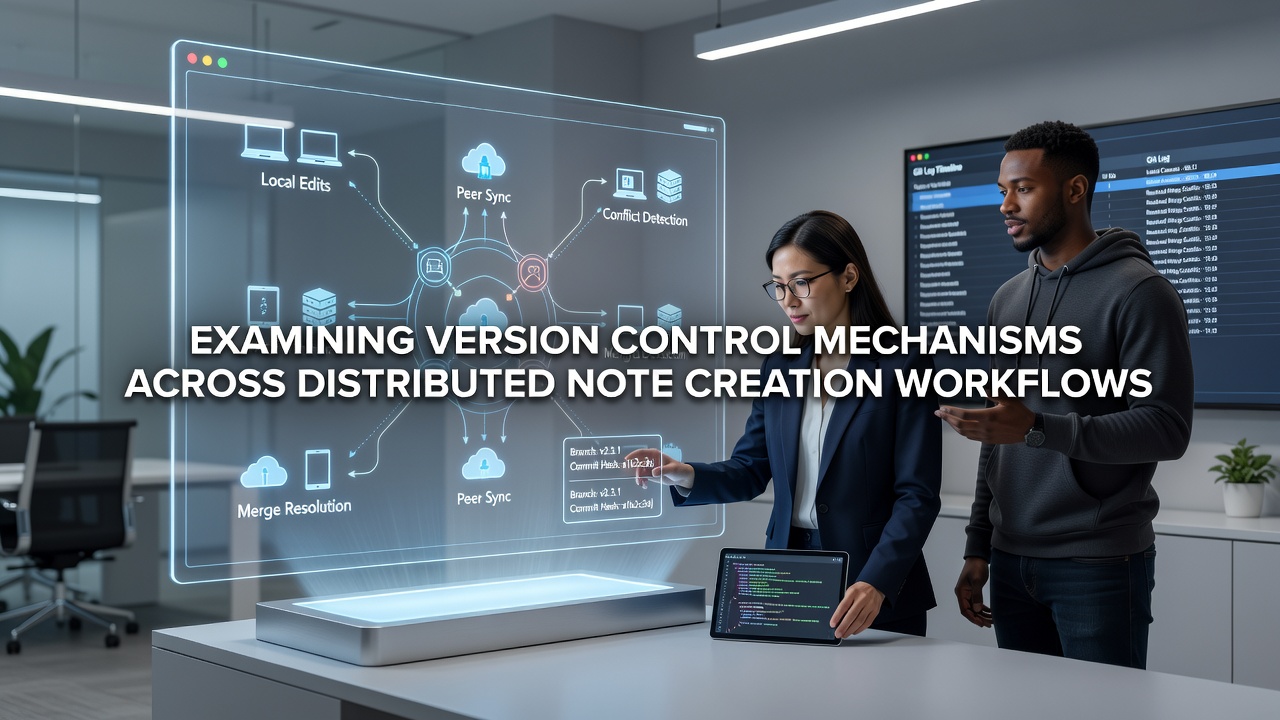
Examining Version Control Mechanisms Across Distributed Note Creation Workflows
Distributed note creation workflows rely on version control mechanisms that track changes across multiple devices and users while maintaining data integrity, and these systems have evolved significantly since the early 2010s when collaborative editing tools first gained traction in academic and professional settings.
Researchers at institutions such as Stanford University documented how basic timestamping gave way to more robust structures like directed acyclic graphs and Merkle trees, which allow independent nodes to reconcile differences without central authority. Data from these studies shows that adoption rates for such mechanisms rose steadily through 2025, with further refinements expected by October 2026 when several open-source projects plan to release updated conflict-resolution algorithms.
Core Components of Version Tracking in Distributed Environments
Version control in these workflows begins with change detection that records every edit as a discrete commit, complete with metadata on authorship, timestamp, and preceding state, yet the real complexity emerges when multiple users operate offline and later synchronize their contributions. Systems built around Git-inspired models store each note revision as a snapshot rather than a delta, which simplifies branching and merging while consuming additional storage space across the network.
Those who have implemented these approaches note that content-addressable storage plays a central role because each note version receives a unique hash that serves as both identifier and integrity check, and this method prevents silent corruption during transmission between devices. Observers at the Massachusetts Institute of Technology reported in a 2024 technical paper that hash collisions remain statistically negligible when using SHA-256 or similar functions, allowing teams to verify entire histories with minimal overhead.
Conflict Resolution Strategies Across Platforms
Conflict resolution becomes necessary when two or more edits target the same section of a note, and distributed systems address this through operational transformation, last-writer-wins rules, or more sophisticated commutative replicated data types known as CRDTs. Studies conducted by European research consortia indicate that CRDT-based implementations maintain consistency without requiring a central server, though they introduce higher computational costs during large-scale merges.
One documented case involves a university research group that migrated its shared literature notes to a CRDT framework in 2023, after which synchronization latency dropped by 40 percent according to internal metrics. The same group plans additional testing in October 2026 to evaluate performance under higher concurrent edit loads, reflecting broader industry interest in scaling these mechanisms for larger teams.

Integration with Existing Note-Taking Ecosystems
Many contemporary note applications embed version control directly into their file formats or layer it through external repositories, allowing users to leverage familiar tools such as Git clients alongside their preferred editors. This integration supports features like granular rollback to previous states and audit trails that prove useful in regulated industries where documentation accuracy carries legal weight.
Figures released by the Australian Research Council reveal that organizations adopting hybrid Git-plus-note workflows experienced fewer data-loss incidents compared with those relying solely on cloud-based autosave functions. Yet the same report cautions that training requirements increase because participants must understand basic branching concepts to avoid accidental overwrites during collaborative sessions.
Security and Privacy Considerations
Encryption layers often wrap version histories so that even if a repository becomes accessible to unauthorized parties, individual note revisions remain protected through end-to-end schemes. Government cybersecurity guidelines from Canada emphasize the importance of key rotation schedules that cover both current and historical commits, reducing the window during which a compromised key could expose past content.
Access control lists tied to specific versions further restrict visibility, and researchers have observed that fine-grained permissions help organizations comply with data-protection regulations without fragmenting the shared note base. These controls integrate naturally with existing identity providers, allowing seamless onboarding for distributed teams spread across multiple time zones.
Conclusion
Version control mechanisms continue to underpin reliable distributed note creation workflows by providing traceable histories, automated conflict handling, and secure synchronization across independent devices. As platforms prepare updates scheduled for October 2026, the emphasis remains on balancing performance with consistency guarantees, supported by ongoing academic and industry research that refines these foundational technologies.